Open Source Commentary - Examining the MIT License As An Activist

The conversation about software licensing has become increasingly polarized.
On one side, you have advocates of permissive licenses like MIT who argue for maximum freedom with minimal restrictions. On the other, you have copyleft proponents who believe that freedom requires enforcement mechanisms to ensure that modifications remain open.
Both positions have merit. Both have flaws. And both have contributed to the infrastructure we rely on today.
The MIT License: What It Actually Says
The MIT license grants users the freedom to modify, distribute, copy, and sell software without major restrictions. The only obligation is that you must include the original license text and copyright information. That's it. No requirement to share modifications. No requirement to open your source code. No restrictions on commercial use.
The case for MIT:
The MIT license is simple. It's short. It's legally clear. It creates the least friction for adoption. Companies can use it without fear that their legal departments will have heart attacks. It's been battle-tested for decades.
When you release code under MIT, you're saying: "Here's my work. Do what you want with it. I trust you."
This approach has led to widespread adoption. React, Node.js, jQuery, Bootstrap, and thousands of other critical projects use MIT. It's the default license for much of the modern web.
The case against MIT:
Critics argue that MIT is naive. By allowing anyone to take the code and close it up, you're enabling corporations to profit from community work without contributing back. The "free rider" problem is real. Amazon can take open source software, run it on AWS, and return nothing to the community that built it.
Richard Stallman has argued that this creates a system where the powerful benefit from the work of the many, without reciprocating. In "The Right to Read," he painted a dystopian picture of what happens when knowledge becomes controlled—and argued that we need mechanisms to prevent that control.
---
The Copyleft Alternative: GPL and Its Progeny
Copyleft licenses like the GPL take a different approach. They grant you freedom to use, modify, and distribute the software, but with a condition: if you distribute modifications, you must also share the source code under the same license.
The case for copyleft:
Copyleft ensures that the code remains free. It prevents companies from taking open source work, modifying it, and closing it up. It creates a commons that cannot be enclosed. The Linux kernel, the GNU tools, and thousands of other critical projects use GPL.
Stallman's vision was that code should be free for everyone, and that "free" should be enforced. He saw what happens when corporations control access to knowledge—the DMCA, the copyright extensions, the DRM—and he built a license designed to resist those forces.
The case against copyleft:
Copyleft creates friction. It makes corporations nervous. It limits adoption. Many companies will simply avoid GPL-licensed code entirely, rather than deal with the compliance requirements. The GPL has been described as "viral" because it can force entire codebases to adopt its terms.
Additionally, copyleft only works when distribution happens. With the rise of software-as-a-service, companies can use GPL-licensed code on their servers without ever distributing it—and therefore without ever sharing their modifications. This is the "ASP loophole" that the AGPL was designed to close, but it remains contentious.
---

Stallman Was Right About the Problem
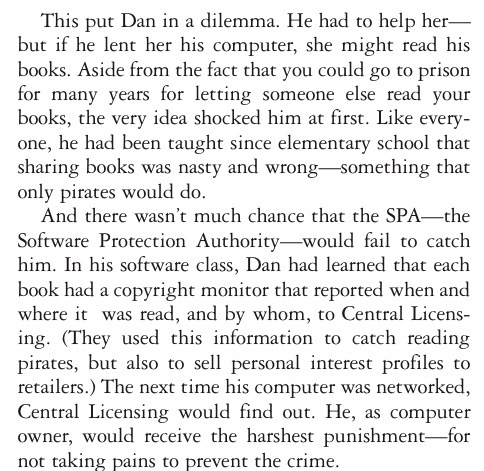
Richard Stallman's "The Right to Read" isn't a dystopian fantasy. It's a roadmap of what we're already living through. The DMCA made breaking DRM a crime. Copyright monitors that report reading habits to central authorities aren't fiction—they're exactly what happens when you read a Kindle book or watch Netflix.
When Stallman wrote about students being banned from computer systems for circumventing monitoring, he was describing every school that uses surveillance software to track student activity. When he wrote about debuggers being illegal, he was describing the reality that tools for security research are increasingly restricted.
The problem Stallman identified is real: corporations and governments are building systems of control over knowledge. The question is not whether this is happening—it's what to do about it.
---
Where MIT and Copyleft Converge
Despite their differences, MIT and copyleft share common ground:
1. Both reject proprietary software's core premise. Both argue that source code should be available, that users should have the right to modify software, and that knowledge should not be locked away.
2. Both have contributed to a commons. The Linux kernel (GPL) and the Apache web server (Apache License) both underpin the internet. Node.js (MIT) and the GNU tools (GPL) are both essential. The commons exists because of both traditions.
3. Both respond to the same threat. DRM, surveillance, software patents, and copyright extension affect everyone. Both MIT and copyleft advocates oppose these developments.
---
Both Approaches Work
The evidence shows that both MIT and copyleft have led to successful, widely-used software. The Linux kernel runs the world. React powers the web. Both are foundational. Both have contributed to the open source ecosystem.
What matters more than the license is the community around the project. A healthy project with a clear governance structure will attract contributors regardless of license. A toxic project with unclear leadership will fail regardless of how "free" the license is.
The corporations that build on open source don't need to be forced to give back. They give back because it's in their interest. They give back because the ecosystem that benefits them requires maintenance. They give back because the alternative—maintaining everything themselves—is more expensive.
This isn't always true. Some companies take and never give. But on balance, the open source ecosystem functions remarkably well.
---
As a Cypherpunk Activist
From a cypherpunk perspective, the choice between MIT and copyleft is less important than the larger goal: building systems that resist control.
Cypherpunks have historically been pragmatic. Use encryption, sure. But also use whatever software works, and contribute to making it better. The goal is operational security and resilience. The goal is building infrastructure that can't be shut down.
Some cypherpunks prefer MIT because it creates the least friction. Others prefer GPL because they believe enforced openness is the only way to maintain a commons. Both positions are reasonable. The important thing is that they're building.
---
What You Should Consider
If you're choosing a license for your project, here are the questions to ask:
What's your goal? If you want maximum adoption and minimal barriers, MIT is the clear choice. If you want to ensure that all derivatives remain open, GPL is more appropriate.
Who is your audience? If you're building for hobbyists and open source projects, either works. If you're building for enterprise, MIT is less likely to scare away users.
What's your relationship to the commons? Do you believe that the community should enforce openness, or do you trust the market to handle it? There's no right answer—only trade-offs.
What's your comfort with risk? MIT is simple and battle-tested. GPL has more legal complexity. Both have established case law, but MIT is more straightforward.
---
The Bottom Line
Neither MIT nor copyleft is "the only moral choice." Both have legitimate arguments. Both have strengths and weaknesses. Both have produced critical infrastructure.
What matters is that you're building, and that you're thinking about these questions. The worst outcome is not choosing MIT or GPL—the worst outcome is choosing proprietary, closed, controlled software that locks knowledge away.
Stallman was right to warn us about the future. The DMCA is real. DRM is everywhere. Surveillance capitalism is not a conspiracy theory—it's a business model.
But Stallman's solution isn't the only solution. The MIT license has proven itself as a tool for building free software. It doesn't enforce openness—it assumes goodwill. So far, that assumption has largely worked.
You should build on both traditions. Use MIT for your libraries. Use GPL for your tools. Fork, modify, distribute. Contribute back when you can. Build infrastructure that can't be controlled.
The corporations will take what you build. They'll build billion-dollar companies on it. They'll use it and sometimes abuse it.
And we'll keep building. Because that's the cypherpunk way.
---
This article draws on ideas from Richard Stallman's "The Right to Read," the history of the MIT and GPL licenses, and years of observing how open source actually works in practice. The goal isn't to prescribe a single path forward—it's to clarify the trade-offs so you can make your own informed choice.