Mesh Broadcasting - Building Tactical Private LTE Networks

When communication infrastructure fails or doesn't exist, traditional two-way radios (VHF/UHF) are a solid fallback for voice, but they fall short for data-heavy operations.


Tactical teams require more than voice—they need high-bandwidth data, encrypted streams, and real-time location sharing.
By deploying a portable Private LTE network, teams can leverage their existing smartphones with a simple SIM card swap, turning off-the-shelf hardware into a resilient, high-speed data ecosystem.
The Portable Agency

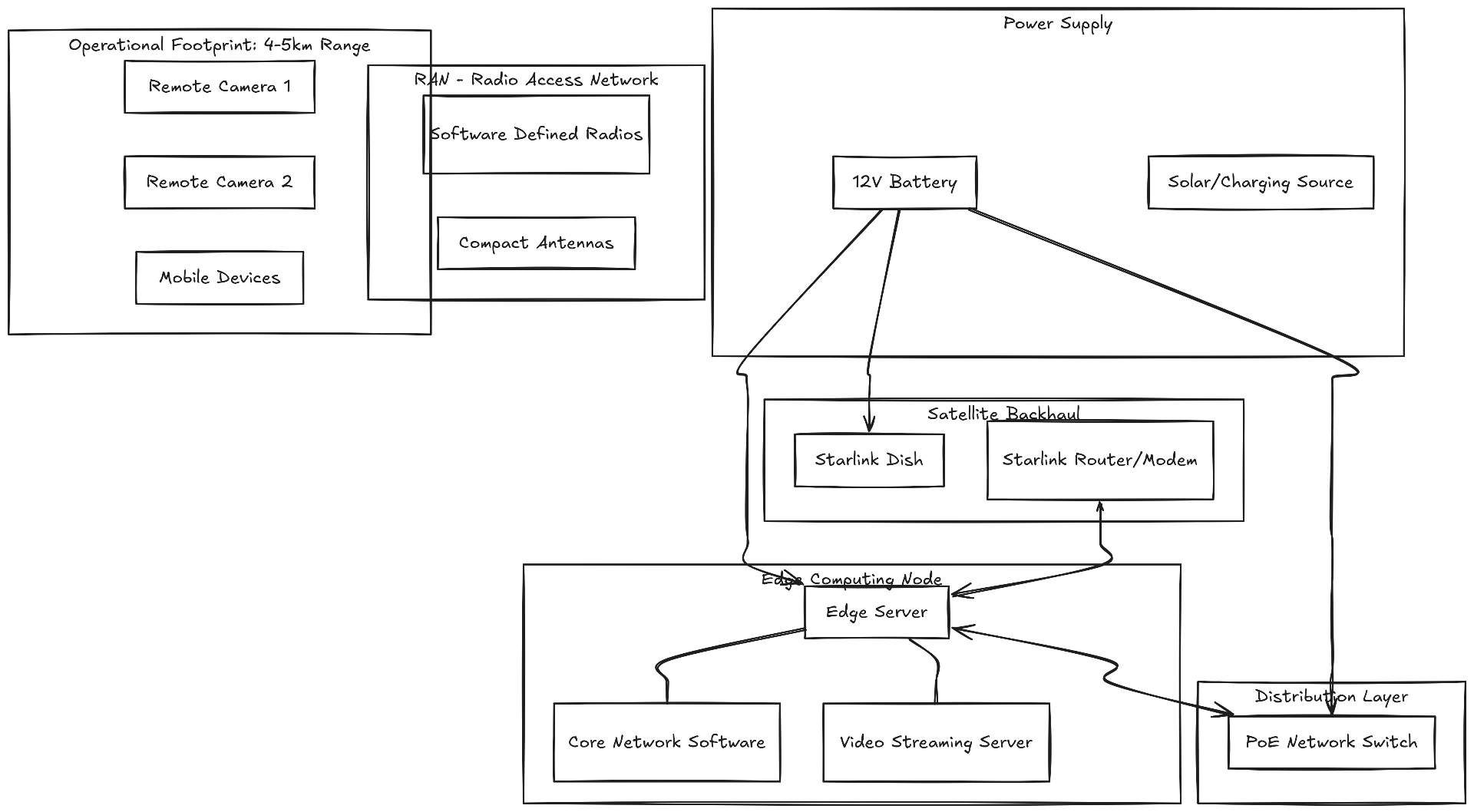
A field-deployable LTE setup is entirely modular. Powered by a standard 12V battery, a baseline kit consists of:
- An edge server running core network software
- A Power over Ethernet (PoE) network switch
- Compact antennas and software-defined radios
This lightweight architecture easily achieves a footprint of 4–5 km in range while actively streaming real-time video feeds.
Distributed Software Ecosystem: Open5GS & OpenPack
Building these independent networks relies on open-source cellular infrastructure software rather than proprietary telecom hardware:
- Open5GS: An open-source project providing an implementation of the 5G Core and EPC (Evolved Packet Core) to handle the cellular routing and logic. Learn more at open5gs.org.
- OpenPack: Helps orchestrate and bundle tactical deployments for field scenarios. Explore their tooling at openpack.com.
For technical blueprints and integration guides combining these specific platforms, resource documentation can help
Tactical Versatility & ATAK Integration
These private networks are built to support situational awareness tools like ATAK (Android Team Awareness Kit). Instead of relying on commercial cell towers, ATAK endpoints sync peer-to-peer over the private cellular bubble to map locations, share markers, and coordinate movements.
Furthermore, the network's versatility extends far beyond smartphones. It acts as an umbrella for:
- IP cameras and automated sensors
- Unmanned aerial vehicles (drones)
- Ground-based telemetry devices
The network operates entirely offline by default, keeping localized data secure. If external reach is required, it seamlessly links with satellite backhauls like Starlink for global internet access.
Operational Security & Redundancy
Cellular technology provides highly secure encryption against standard interception and hacking vectors out of the box, provided that local data management at the base of operations is configured properly
However, tactical infrastructure should never rely on a single point of failure. A Private LTE network is meant to complement, not completely replace, existing communication methods. Teams should always maintain secondary, independent voice systems (such as legacy VHF/UHF radios) as a fallback layer .
Note on Style: When designing custom schemas or APIs to push telemetry data across these networks, ensure your data objects conform to clean API patterns, such as utilizing lowerCamelCase conventions and avoiding unextendable enums.
Prerequisites
To encapsulate , for a tactical private LTE setup:
- Power Source: A standard 12V battery to supply mobile power to the system.
- Core Server: An edge server configured to run the core network infrastructure software.
- Network Infrastructure Software: - Open5GS: Open-source software implementing the 5G Core and Evolved Packet Core (EPC) to manage cellular routing.
- OpenPack: Software framework to bundle and orchestrate the tactical deployment.
- Networking Hardware: A Power over Ethernet (PoE) network switch to interconnect and power the edge components.
- RF Componentry: Software-defined radios or LTE-capable radios paired with compact antennas to broadcast the cellular signal.
- User Endpoint Hardware: Standard commercial smartphones equipped with custom network SIM cards.
- Situational Awareness Software: Android Team Awareness Kit (ATAK) installed on user devices for mapping and peer-to-peer data syncing.
- Optional Satellite Backhaul: A Starlink terminal (or equivalent satellite link) if external internet access is required.
Lifecycles - Procurement, Operations, and Maintenance for Tactical Networks
Building a standalone cellular network shifts the paradigm of data ownership back into your hands. However, treating a private network purely as a software configuration project misses the broader operational reality. To successfully transition from a laboratory concept to a resilient field deployment, you must understand the complete lifecycle of the system: how it is sourced, how it is deployed, and how it is sustained.
Procurement: Sourcing the Infrastructure
Procuring a tactical network requires a balance between hardware resilience and cost-efficiency. The physical demands of your operating environment will dictate your hardware selection.
- Field vs. Static Deployments: For mobile operations, hardware should be acquired inside ruggedized, portable boxes designed to survive transport and harsh weather. For fixed, static, or non-mobile environments, you can drastically reduce procurement costs by repurposing standard commercial or enterprise hardware—such as older desktop computers—to serve as your network server.
- The Core Hardware Stack: Sourcing the network hub requires acquiring four foundational hardware elements
- The Server Unit: A computational node capable of running open-source network core logic.
- PoE Network Switch: A Power over Ethernet switch featuring a WAN input port to serve as the physical network connectivity hub.
- Radios and Antennas: Specialized RF hardware capable of broadcasting cellular bands and communicating directly with endpoint devices.
- Power Hardware: A reliable 12-volt battery system paired with an inverter capable of handling solar charging inputs.
Operations: Deployment and Signal Physics
Operating a private network means managing both the software core and the literal physics of RF line-of-sight.
- The Leverage of Elevation: When establishing network coverage, elevation is the single most critical factor for performance. Elevating your broadcast antennas clears ground-level physical obstructions between user endpoints and the tower, directly maximizing the signal's maximum reach and maintaining data link stability.
- Traffic Routing and Backhaul: The central server runs orchestration tools like Open5GS and OpenPack to handle core cellular routing and manage ATAK capabilities. This data moves locally through the PoE network switch, which distributes power to the radios via standard Ethernet cabling. If your local operation requires global internet access, the switch's WAN input allows you to tie directly into satellite backhauls like Starlink.
- Device Versatility: Once the cell bubble is live, your infrastructure acts as a completely private data highway. It seamlessly connects a diverse array of hardware—including smartphones, remote field cameras, and drones—allowing them to stream data securely over your own self-hosted backbone.
Maintenance: Power Management and Architecture Evolution
A network is only as good as its uptime. Long-term maintenance ensures physical power continuity and clean software evolution.
- Power Continuity: Field systems are constrained by battery capacity. Maintaining an uninterrupted power lifecycle requires connecting your 12-volt battery to an inverter, allowing solar panels to continually cycle power back into the system during daylight hours.
- Hardware Audits: Routine physical maintenance involves auditing the cable connections on your PoE switch and checking the placement of antennas to ensure direct communication channels with mobile endpoints remain uncompromised.
- Software and Schema Upkeep: As your network expands to ingest new types of device telemetry, developers must write custom APIs and data schemas. To ensure your custom software additions do not introduce breaking changes, baseline engineering principles should be observed .
- Casing Standards: Maintain strict lowerCamelCase naming conventions for custom data attributes.
- Schema Flexibility: Avoid restrictive, closed enum sets for string properties; utilize flexible token extensions instead to allow the platform to evolve.
- Data Structuring: Keep data fields optional unless absolutely critical, and use object layers inside arrays rather than raw atomic types to give your network code room to grow over time.